

Course 03
Impedance Matched Multi-Axis Vibration Testing (IMMAT)
NVT University is pleased to announce the next hands-on training course focused on Impedance Matched Multi-Axis Vibration Testing (IMMAT). This course is designed for engineers and test professionals seeking to reproduce real-world structural vibration response with greater accuracy than traditional single-axis methods or even multi-axis methods.
Date: August 4-6
Location:
Brigham Young University, Provo, Utah
Course Overview
Impedance Matched Multi-Axis Testing (IMMAT) is an advanced vibration testing methodology that focuses on reproducing the true dynamic response of a Device Under Test (DUT). Rather than controlling vibration at a single point or axis, IMMAT uses measured field vibration data and structural mode shapes to determine the excitation required at multiple locations on the DUT.
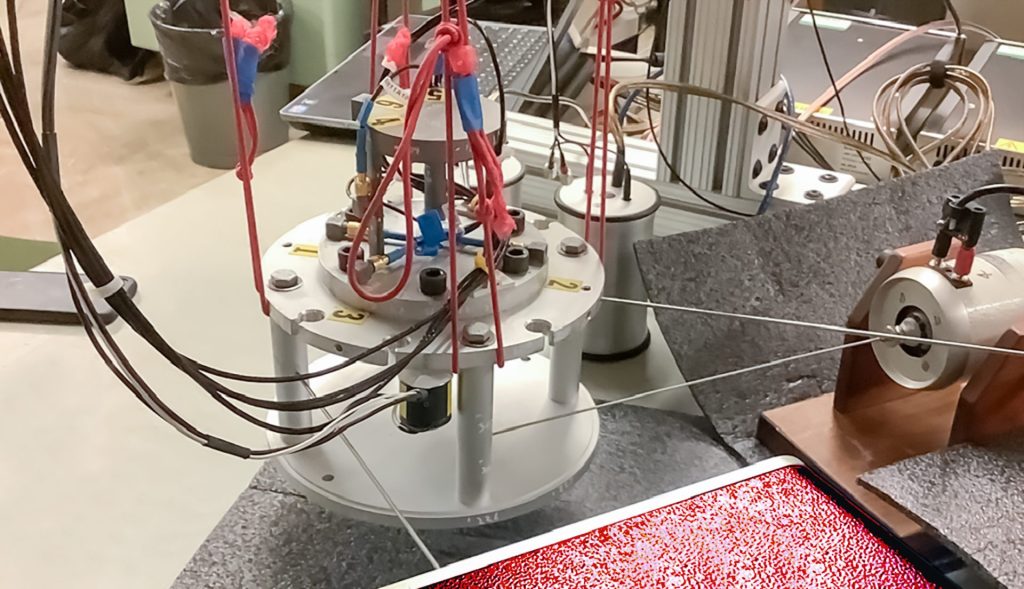
Scenes from the 3-Day Course which Provided Technical Insights as Well as Practical, Hands-On Instruction
Quality over Quantity
Lectures are presented in a clear and concise manner by instructors who have more than 20 years experience in vibration control and signal analysis. Classes are kept small enough to foster communication between students and instructors. Class size is limited, and instructors are available to answer questions that students may have.
Registration for this course has closed.
Lead Instructor: Raman Sridharan
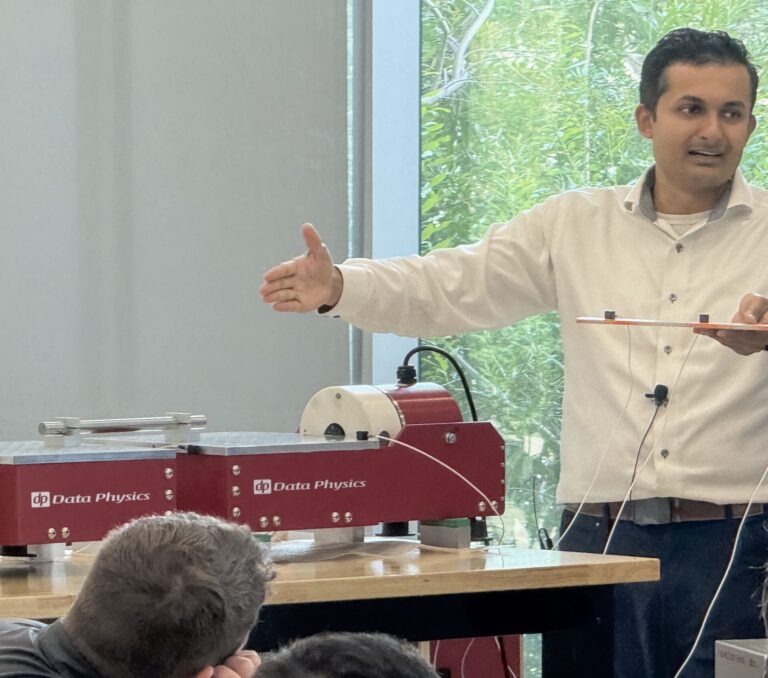
Raman Sridharan is Senior Product Manager at Data Physics Corporation, with a focus on Multi-Shaker control.
Raman completed his undergraduate studies in Mechanical Engineering from University of California at Berkeley, and began working for Data Physics Corporation as an Application Engineer working on DSP products. He completed his M.S. in Mechanical Engineering at University of Maryland, College Park with a thesis topic on fatigue induced by Multi-DoF vibration.
Raman has since been focused on developing Data Physics’ next generation Multi-Shaker Controller product and has been involved with Multi-Shaker vibration test labs around the world. Raman has recently begun focusing on NVT University courses, which all focus on advanced MIMO Shaker Control techniques.
Hosted by BYU's Matt Allen

Dr. Matt Allen is a Professor in Mechanical Engineering at Brigham Young University.
Prior to that he taught for 15 years in the department of Engineering Physics at the University of Wisconsin-Madison. He received a B.S. in Mechanical Engineering from BYU, M.S. and PhD degrees from the Georgia Tech in 2005 and was a post-doc at Sandia National Laboratories.
He has developed robust experimental/analytical substructuring methods, a new framework for identifying linear time-periodic systems, continuous-scan laser vibrometry methods, and model updating techniques for geometrically nonlinear systems based on nonlinear normal modes.
He has worked in the area of dynamic environment testing in collaboration with the Kansas City National Security Campus for about a decade. That work has focused on multi-input-multi-output (MIMO) test methods such as IMMAT and a variant called Transmission Simulator IMMAT (TS-IMMAT). Their work seeks to employ the Smart Dynamic Testing principles espoused by Ewins, Ind, Roberts & Daborn by blending simulations of tests with actual experiments.
Dr. Allen and his PhD student Marcus Behling recently published a review paper on smart dynamic testing and are beginning to explore new ways of defining dynamic environments that focus more on the potential of the environment to induce damage into a device under test, while ensuring that the environments can be controlled in the laboratory.
Who Should Attend
- Test engineers
- Structural dynamics and modal analysis engineers
- Test managers and quality engineers
- Professionals conducting MIL-STD and environmental testing
- Product testing and product evaluation teams
Why Attend This Course?
Traditional vibration testing methods often fail to accurately represent real-world conditions. IMMAT addresses these limitations by accounting for multi-axis excitation, mechanical impedance, and realistic force inputs. This course translates advanced IMMAT concepts into practical, executable testing strategies.
What You Will Learn
- Fundamentals of impedance and structural dynamics
- Key differences between traditional vibration testing and IMMAT
- Field data acquisition strategies for IMMAT testing
- Reducing measured data for laboratory reproduction
- Designing impedance-matched laboratory test setups
- Multi-shaker excitation and control strategies
- Executing, validating, and troubleshooting IMMAT tests
NVTU courses, theory as well as practical, hands-on instruction.
Key Benefits of IMMAT Vibration Testing
1. Realistic Structural Response: Reproduces how the DUT actually deforms and responds in service.
2. Multi-Axis, Multi-Input Excitation: Uses multiple shakers exciting discrete locations simultaneously.
3. Improved Correlation to Field Data: Matches modal behavior between field and laboratory configurations.
4. Balanced Impedance and Controllability: Achieves realistic results without unnecessary test complexity.
5. Advanced Control Techniques: Reduces drive force requirements while maintaining controllability.
Course 03 Syllabus
Impedance Matched Multi-Axis Vibration Testing (IMMAT)
DAY 1
Course Overview
- IMMAT Overview
- Vibration Modes
- Random Vibration Environments
- Degrees of Freedom
- Multi Shaker Control
- IMMAT on Simple Structure
- IMMAT on a Complex Structure
Vibration Fundamentals
- Rigid Body Dynamics
- Modes
- FEA, Modal Analysis
BREAK
Characterizing Real Word Vibrations
- Random Vibration
- Response to Random Vibration
- Power Spectral Density
- Multi-DoF Vibration Environments
- Spectral Density Matrix
LUNCH
Degrees of Freedom
- Rigid body degrees of freedom
- Multi-DoF Base Excitation
- Modal degrees of freedom
- Non Rigid Body Motion and Spectral Density Matrices
- Relationship to Fatigue Damage
- Base Excitation vs. IMMAT
Multi Shaker Control
- Signal Processing Overview
- Frequency response matrix
- Control matrix inversion
- Control Degrees of Freedom
- Effect of Modes
Q&A Session
DAY 2
Hands-On Lab:
IMMAT on Simple Structure
- FEA/Modal Importance
- Choice of Accelerometer Locations
- Recording Spectral Density Matrix
- Reproducing Specific Modes
- Choice of Shaker Locations
- Boundary Condition Changes
- Control Degrees of Freedom
LUNCH
Interpreting Results
- What is a good result
- IMMAT on Complex Structure
- Part 1
Q&A Session
DAY 3
Hands-On Lab:
IMMAT on Complex Structure
- Part 2
Q&A Session


Course Location
Weidman Center (conference room)
Where to Park
BYU Lot 26V
E 1100 N St, Provo, UT 84604
Area Lodging
Hands-On Training and Demonstrations
We understand that students learn by example, which is why live demonstrations are critical to the course.
Demonstrations used throughout the classes highlight specific application issues. Students learn how to solve real-world problems that are often encountered while working in the field.
Future NVT University Courses Include:
Multi-Degree of Freedom (MDoF) featuring the Team Corporation Tensor™ 6DoF Electrodynamic Shaker
Products do not experience vibration a single axis at a time in the real world. Simultaneous multi-degree of freedom vibration testing can speed up testing and reproduce failures that cannot be reproduced by sequential single-axis testing.
Multi-degree of freedom testing is currently in use in a variety of military, aerospace and automotive applications.
This course will cover the fundamentals of vibration, signal processing and multi-degree of freedom vibration testing with a focus on six degree of freedom testing. The course will include demonstrations and will have a focus on hands-on training with a Team Corporation Tensor 6-DoF electrodynamic shaker system and a Data Physics MIMO vibration controller.
Vibration Testing Using Electrodynamic Shakers
This course will cover the fundamentals of vibration, signal processing and single shaker vibration testing. It will also cover the operation and maintenance of electrodynamic shakers. The course will include demonstrations and will have a focus on hands-on training with electrodynamic shakers.