

Course 02
Multi-Shaker Single-Axis Vibration Testing for Large Test Articles
This NVT University 3-day hands-on course is designed to teach the underlying theory of multi shaker single axis vibration testing while maximizing practical experience with vibration testing equipment in the laboratory. The course is recommended for both Operators and Test Engineers.
Date:
June 24-26, 2025
Location:
Texas A&M University
Zachry Engineering Education Complex
125 Spence St. College Station, TX 77840
Scenes from the 3-Day Course which Provided Technical Insights as Well as Practical, Hands-On Instruction
Critical Insights for Safe and Accurate Multi Shaker Vibration Testing
In this in-depth video, we reveal the multiple, inherent engineering challenges that are typical with multi shaker single axis testing and offer proven solutions to help you overcome them.
You’ll gain insights into the complexities of multi-shaker vibration testing and how to avoid costly mistakes by employing a properly configured vibration control system.
Who Should Attend?
Test technicians / Test engineers / Quality engineers conducting MIL STD testing, product testing, or product evaluation
You’ll gain insights and practical, hands-on experience with multi-shaker single-axis vibration testing.
Key Benefits of Multi Shaker Single-Axis Vibration Testing
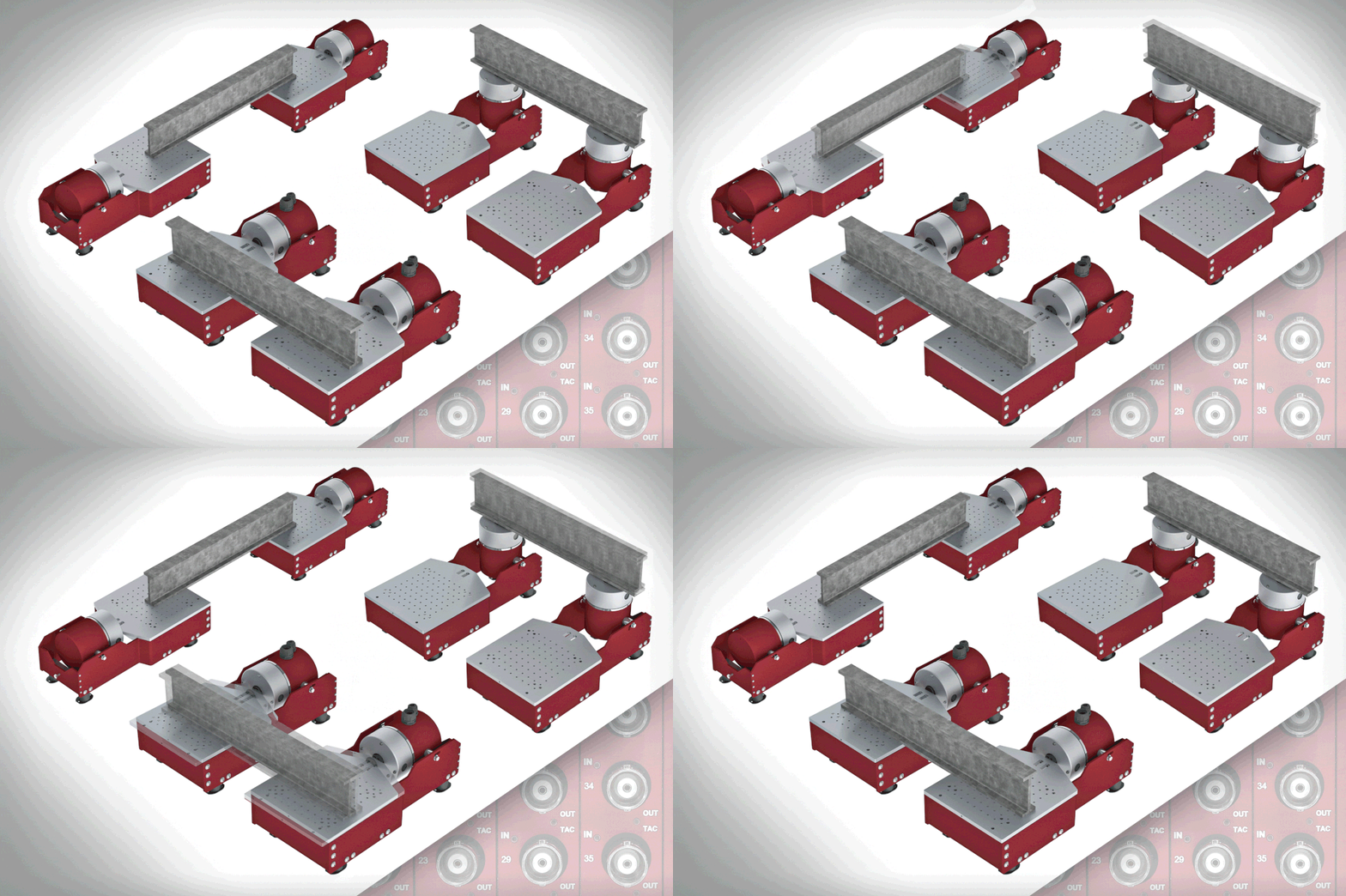
Students will run tests in the following multi-shaker configurations: Push-push horizontal, push-push vertical, and push-pull horizontal.
Overview
The demand for the testing of very large test articles is increasing. Typically, this requirement is met with very large electrodynamic shakers (approximately 45 klbf to 60 klbf). Shakers of this size are limited in frequency range, and some tests require more force than is available with a single shaker.
Multi-shaker single-axis testing enables testing that combines the force of multiple shakers to produce the higher force required. It also adds the flexibility of separating the shakers for individual tests of smaller test articles when higher force levels are not required — and without the reduction in frequency range associated with very large shakers.
This course will cover the fundamentals of vibration, signal processing and multi-shaker testing with a focus on multi-shaker single-axis testing.
Also included: How to avoid shaker damage when conducting multi shaker testing.
The course will include demonstrations and hands-on training with multiple shakers in single-axis push-push and push-pull configurations.

Hosted by: TAMU MEEN (J. Mike Walker ’66 Department of Mechanical Engineering) and the FAST Lab (Fusion of Analysis, Simulation, and Testing Laboratory.

Location Details
Texas A&M University
Zachry Engineering Education Complex
125 Spence St College Station
On-Campus Parking
Polo Road Garage, Polo Road College Station
Validation provided.
Area Lodging
TEXAS A&M HOTEL AND CONFERENCE CENTER
177 Joe Routt Blvd, College Station, TX 77840
THE GEORGE
180 Century Ct, College Station, TX 77840
THE STELLA HOTEL
4100 Lake Atlas Dr, Bryan, TX 77807
HILTON COLLEGE STATION
801 University Dr E, College Station, TX 77840
EMBASSY SUITES
201 University Dr E, College Station, 77840
HYATT PLACE
1100 University Dr E, College Station, 77840
Course 02 Overview
Training Objectives
Students will learn how to effectively set up and use a dual shaker test systems for high-force applications where more than one shaker is required.
Emphasis will be placed on:
- Vibration and signal analysis fundamentals for vibration testing
- Technical challenges of a multi shaker single axis vibration test
- Set up and operation of multi shaker single axis vibration tests
- Technical differences between various multi shaker single axis vibration test configurations
- Hand-on experience running, understanding data, and troubleshooting issues
Who Should Attend
- Prospective customers
- Test technicians
- Test engineers
- Test managers
- Space flight hardware test engineers
- Engineers testing of large test articles
- Professionals involved in the following fields:
- Product testing
- Product evaluation
- Stress screening
- MIL STD testing
Instructors
Lectures are presented in a clear and concise manner by instructors who have more than 20 years experience in vibration control and signal analysis. Classes are kept small enough to foster communication between students and instructors. Class size is limited to 15 students, and instructors are available to answer questions that students may have.
Hands-On Training and Demonstrations
We understand that students learn by example, which is why live demonstrations are critical to the course. Live demonstrations illustrating various dual shaker single axis configurations will be presented during the course, and common configurations will be discussed in detail. Each configuration will include a technical assessment, as well as a detailed instruction on how to properly configure the controller for that configuration.
Demonstrations used throughout the classes highlight specific application issues. Students learn how to solve real-world problems that are often encountered while working in the field.
Course 02 Syllabus
Multi-Shaker Single-Axis Vibration Testing for Large Test Articles
DAY 1
Course Overview
• Signal Processing fundamentals
• Vibration fundamentals
• Single shaker control
• Degrees of freedom and Kinematic Transformation
• Multi-actuator control
• Common Multi-actuator control issues
Signal Processing Fundamentals
• Digitization
• Dynamic Range
• Time vs. Frequency
• Frequency Response Functions
• Multi-input Frequency Response Functions
Vibration Fundamentals
• Rigid body dynamics
• Spring/Mass/Damper
• Non-Rigid Body dynamics, Modes
BREAK
Single Shaker Control
• Frequency Response Function
• Pretest Reports
• Control Schemes
– Sine
– Random
– Shock
– Replicator
• Effect of Modes
LUNCH
Degrees of Freedom
• Degrees of freedom overview
• Rigid body degrees of freedom
• Bearings
• Reaction mass
• Existing Multi-axis test setups
• Modal degrees of freedom
• Control Accelerometers, Rank
• Placement of shakers
The Incorrect Way to Control Two Shakers
• Historical review of dual shaker control
• Common ways two shakers are “controlled”
• What could go wrong?
BREAK
Q&A Session
DAY 2
Multi Shaker Control
• Frequency response matrix
• Control Degrees of Freedom
• Control matrix inversion, Singular values
• Pretest Reports
• Effect of Modes
Multi Shaker Random
• Spectral Density Matrix
• Setting up a Multi Shaker Random Test
– Channel Settings
– Control Settings
– Run Schedule
• Running a Multi Shaker Random Test
LUNCH
Multi Shaker Sine
• Multi Shaker Sine Profiles
• Setting up a Multi Shaker Sine Test
– Channel Settings
– Control Settings
– Run Schedule
• Running a Multi Shaker Sine Test
BREAK
Q&A Session
DAY 3
Multi Shaker Classical Shock, Transient, and SRS
• Setting up a Multi Shaker Shock Test
– Channel Settings
– Control Settings
– Classical Shock Settings
– Transient Settings
– SRS Reference Settings
– Run Schedule
• Running a Multi Shaker Shock Test
BREAK
LUNCH
Dual Shaker Single Axis Configurations
• Push/Push (adjacent)
• Push/Pull (single DoF)
• Push/Pull (multi DoF)
• Effect of Modes of the table
• Effect of Modes of the fixture / DUT
Q&A Session
Included in Course 02:
Learn How to Avoid Shaker Damage
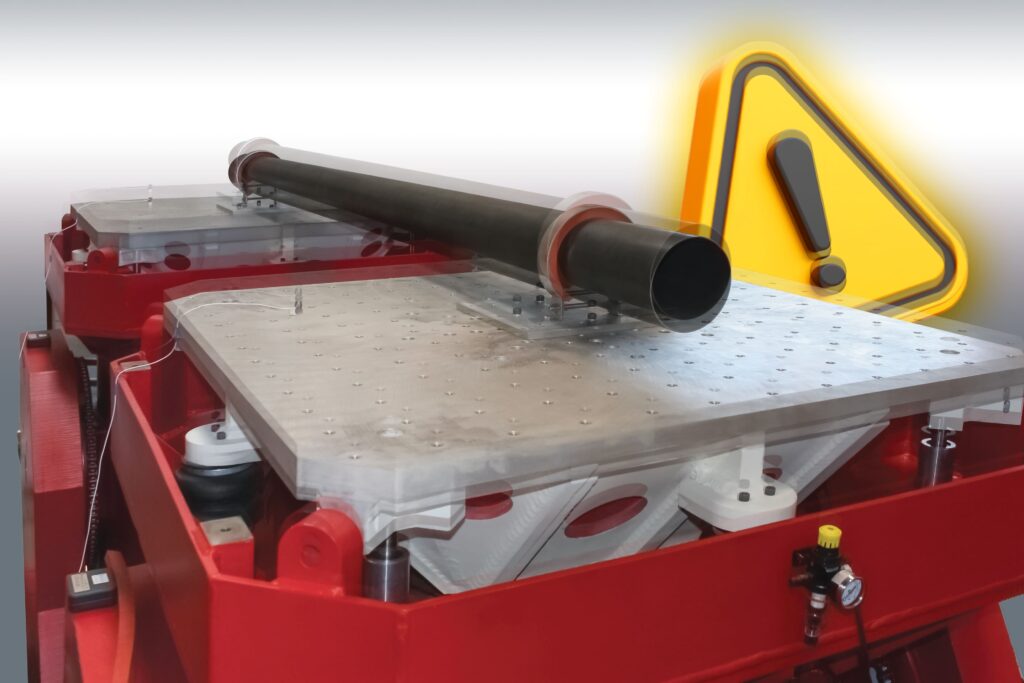
Running two shakers together to drive a single test table or test article is a common way to achieve a higher force capability. But when doing so, there is a serious risk of damaging your shakers or over-testing your test article – and the only way to ensure this doesn’t happen is to have the correct controller.
Many controllers will just split the drive signal to two shakers, use a “phase matching” piece of electronics, or use two separate control loops to try and coax two shakers to work well together. This not only gets suboptimal results – it is risky.
When driving two shakers in such a way, the controller has no way to know if the shakers are fighting each other. The two shakers can be outputting forces that cancel each other out – and there will be no detectable acceleration response. This is an easy way to overdrive your shakers and exert extreme stress through the test article or table.
To help you avoid these costly mistakes, the 900 Series vibration controller employs a MIMO control algorithm which has the appropriate settings to ensure the shakers don’t fight each other. It measures and uses the exact amplitude and phase response of each shaker – and when generating the drive for each shaker it ensures that they don’t generate opposing forces. This allows for correct control – and more importantly, the safest execution of a dual shaker test.
Read more about these important multi shaker testing safety considerations.
Future NVT University Courses Include:
Impedance Matched Multi-Axis Vibration Testing (IMMAT)
Impedance Matched Multi-Axis Testing is a new method to reproduce a structure’s response to real-world vibration environments. In IMMAT testing, measured data and the test article’s mode shapes are used to determine the excitation required at specific locations to reproduce the measured response in the laboratory.
This course will cover the process of using measured vibration and mode shape data to perform an IMMAT test. The course will include demonstrations and hands-on training with multiple shakers exciting a test article at discrete locations.
Multi-Degree of Freedom (MDoF) featuring the Team Corporation Tensor™ 6DoF Electrodynamic Shaker
Products do not experience vibration a single axis at a time in the real world. Simultaneous multi-degree of freedom vibration testing can speed up testing and reproduce failures that cannot be reproduced by sequential single-axis testing.
Multi-degree of freedom testing is currently in use in a variety of military, aerospace and automotive applications.
This course will cover the fundamentals of vibration, signal processing and multi-degree of freedom vibration testing with a focus on six degree of freedom testing. The course will include demonstrations and will have a focus on hands-on training with a Team Corporation Tensor 6-DoF electrodynamic shaker system and a Data Physics MIMO vibration controller.
Vibration Testing Using Electrodynamic Shakers
This course will cover the fundamentals of vibration, signal processing and single shaker vibration testing. It will also cover the operation and maintenance of electrodynamic shakers. The course will include demonstrations and will have a focus on hands-on training with electrodynamic shakers.