
The reviews are in:
Expert Hands-On Multi Degree of Freedom (MDoF) Vibration Testing for: Test technicians - Test engineers - Quality engineers conducting MIL STD testing - Product testing - Product evaluation
Gain practical experience and see how MDoF testing more accurately represents real-world vibration environments, captures complex interactions between different vibration modes, and provides more comprehensive and predictive data for the durability and safety of a system.
Key Benefits of 6DoF Shaker Vibration Testing
1 Comprehensive Simulation: 6DoF testing accurately represents how real-world conditions affect components, as it allows for the simulation of combined motions that a component may experience during operation, including both linear and angular movements.
2 Realistic Environment: Many applications, especially in aerospace and automotive fields, expose components to complex vibrational environments. 6DoF testing provides a more accurate representation of these environments, ensuring that components are adequately tested. Six Degree of Freedom vibration testing has been shown to reproduce failure modes that can’t be reproduced with sequential single axis tests.
3 Improved Data Collection: The ability to measure responses in all six degrees allows engineers to gather extensive data on how a system behaves under various loading conditions, leading to better insights into performance and potential failure modes.
4 Integration with Advanced Technologies: Modern shaker systems can integrate with data acquisition and analysis tools, enabling real-time monitoring and sophisticated simulations that further enhance testing capabilities.

Course 01
Multi Degree of Freedom (MDoF) Vibration Testing
This inaugural NVT University 4-day hands-on course features the Team Cube™ 6DoF table paired with a Data Physics multi-shaker controller.
Dates: Dec 10-13, 2024
Location: NSWC Facility in Dahlgren, Virginia, USA
Cost: $2,500
Spaces are limited and are accepted on a first-come, first-served basis. Must be a U.S. citizen.
This Couse has completed.
Area Lodging
Country Inn & Suites by Radisson, Dahlgren-King George, VA
4755 James Madison Pkwy, King George, VA 22485
choicehotels.com
(540) 644-1500
Hampton Inn Dahlgren
4391 Hospitality Way, King George, VA 22485
hilton.com
(540) 625-2333
Holiday Inn Express & Suites King George – Dahlgren
16348 Gateway Ln, King George, VA 22485
ihg.com
(540) 625-2034
My Place Hotel-Dahlgren/King George, VA
4235 Market Center, King George, VA 22485
myplacehotels.com
(540) 413-1200
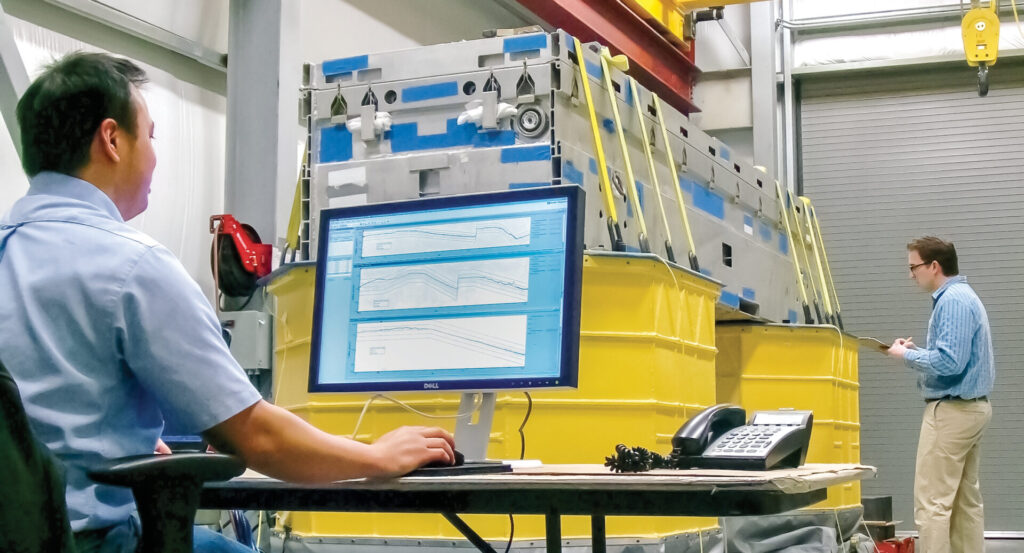
The CUBE™ simulates real-world 6 Degree of Freedom vibration with complete, simultaneous control of the amplitude and phase of all 6 Degrees of Freedom. Offering simultaneous or sequential excitation of test articles in Sine, Random and Time Wave Form Replication, the CUBE™ sets the standard for multi-axis vibration testing.
Course 01 Overview
Multi Degree of Freedom (MDoF) Vibration Testing
Six degree of freedom (6DoF) shaker vibration testing is an advanced method used to simulate and analyze the dynamic behavior of components when subjected to vibration is all directions of movement. This includes translations along the three orthogonal axes (X, Y, Z) and rotations around these axes (roll, pitch, and yaw). Multi-Degree of Freedom Testing requires special shaker tables capable of simultaneous translations in multiple orthogonal axes. It also requires a control system capable of measuring and controlling all six degrees of freedom.
Key Benefits of 6DoF Shaker Vibration Testing
1 Comprehensive Simulation: 6DoF testing accurately represents how real-world conditions affect components, as it allows for the simulation of combined motions that a component may experience during operation, including both linear and angular movements.
2 Realistic Environment: Many applications, especially in aerospace and automotive fields, expose components to complex vibrational environments. 6DoF testing provides a more accurate representation of these environments, ensuring that components are adequately tested. Six Degree of Freedom vibration testing has been shown to reproduce failure modes that can’t be reproduced with sequential single axis tests.
3 Improved Data Collection: The ability to measure responses in all six degrees allows engineers to gather extensive data on how a system behaves under various loading conditions, leading to better insights into performance and potential failure modes.
4 Integration with Advanced Technologies: Modern shaker systems can integrate with data acquisition and analysis tools, enabling real-time monitoring and sophisticated simulations that further enhance testing capabilities.
Applications of 6DoF Shaker Testing
- Aerospace Engineering: Testing components like avionics, control surfaces, and entire aircraft systems to ensure reliability under varied operational conditions.
- Automotive Testing: Evaluating the durability and performance of parts such as suspensions and electronic systems that experience complex vibrational environments.
- Consumer Electronics: Ensuring that devices withstand shocks and vibrations during transport and usage.
In summary, 6DoF shaker vibration testing is preferred for its ability to provide a comprehensive, realistic assessment of dynamic behavior in complex systems, ultimately leading to enhanced safety, reliability, and performance.
Who Should Attend?
Prerequisite: Attendees should have a fundamental understanding of single axis vibration testing.
- New users
- Existing users
- Test technicians
- Test engineers
- Test managers
- Quality engineers
- Professionals involved in the following fields:
- Product testing
- Product evaluation
- Stress screening
- MIL STD testing
Training Objectives
Students will learn how to effectively set up and use vibration test systems for various types of testing requirements.
Emphasis will be placed on:
- Vibration and signal analysis fundamentals for vibration testing
- Operation of vibration equipment and instrumentation
- Data management and report generation for vibration testing.
- Set up and operation of Multi-shaker single axis vibration tests
- Hand-on experience running and troubleshooting vibration tests
The course is designed to teach the underlying theory of Multi-shaker vibration testing while maximizing hands-on experience with vibration testing equipment in the laboratory. The course is recommended for both Operators and Test Engineers.
Instructors
Lectures are presented in a clear and concise manner by instructors who have more than 20 years experience in vibration control and signal analysis. Classes are kept small enough to foster communication between students and instructors. Class size is limited to 15 students, and instructors are available to answer questions that students may have.
Hands-On Training and Demonstrations
Demonstrations are used throughout the classes to highlight specific application issues. Students learn how to solve real-world problems that are often encountered while working with multi shaker test systems.
We understand that students learn through performing, which is why supervised labs are included with tuition. Users will have multiple opportunities to set up and run multiple degree of freedom tests on a Team Corporation Cube 6DoF vibration table.
Course 01 Syllabus
Multi Degree of Freedom Vibration Testing
DAY 1
Course Overview
• Signal Processing fundamentals
• Vibration fundamentals
• Single shaker control
• Degrees of freedom and Kinematic Transformation
• Multi-actuator control
• Common Multi-actuator control issues
Signal Processing Fundamentals
• Digitization
• Dynamic Range
• Time vs. Frequency
• Frequency Response Functions
• Multi-input Frequency Response Functions
Vibration Fundamentals
• Rigid body dynamics
• Spring/Mass/Damper
• Non-Rigid Body dynamics, Modes
• Degrees of freedom
BREAK
Single Shaker Control
• Frequency Response Function
• Pretest Reports
• Control Schemes
– Sine
– Random
– Shock
– Replicator
• Effect of Modes
LUNCH
Degrees of Freedom
• Degrees of freedom overview
• Rigid body degrees of freedom
• Bearings
• Reaction mass
• Existing Multi-axis test setups
• Modal degrees of freedom
• Kinematic transformation
• Control Accelerometers, Rank
• Placement of shakers
Multi Shaker Control
• Frequency response matrix
• Control Degrees of Freedom
• Control matrix inversion, Singular values
• Control Schemes and GUI setup:
• Sine/Random/Shock/Replicator/Mixed Mode
• Pretest Reports
• Effect of Modes
• Modeshape Cancellation
BREAK
Lab #1 and Multi Shaker Control Demos
Q&A Session
DAY 2
Multi Shaker Random
• Setting up a Multi Shaker Random Test
– Channel Settings
– Control Settings
– Run Schedule
• Running a Multi Shaker Random Test
BREAK
Lab #2 Multi Shaker Random
LUNCH
Multi Shaker Sine
• Setting up a Multi Shaker Sine Test
– Channel Settings
– Control Settings
– Run Schedule
• Running a Multi Shaker Sine Test
BREAK
Lab #3 Multi Shaker Sine Hands-on
Q&A Session
DAY 3
Multi Shaker Classical Shock, Transient, and SRS
• Setting up a Multi Shaker Shock Test
– Channel Settings
– Control Settings
– Classical Shock Settings
– Transient Settings
– SRS Reference Settings
– Run Schedule
• Running a Multi Shaker Shock Test
BREAK
Lab #4 Multi Shaker Shock and SRS Hands-on
LUNCH
Multi Shaker Replicator
• Setting up a Multi Shaker Replicator Test
– Channel Settings
– Control Settings
– FRF vs. Drive File Correction
– Run Schedule
• Running a Multi Shaker Replicator Test
• Setting up and Running a Multi Shaker Mixed Mode Test
Lab # 5 Multi Shaker Replicator and Mixed Mode Hands-on
DAY 4
Common Multi-Shaker Control Issues
• Poor pretest
• Degree of freedom issues
• Tuning a Sine test
• Nonlinearities, Hydraulic shakers
• Off-axis modes
• Harmonic distortion
Lab # 6 Additional Hands-on – Typical Control issues
Q&A Session
Future NVT University Courses Include:
Multi-Shaker Single-Axis Vibration Testing for Large Test Articles
The demand for the testing of very large test articles is increasing. Typically, this requirement is met with very large electrodynamic shakers (approximately 45 klbf to 60 klbf). Shakers of this size are limited in frequency range, and some tests require more force than is available with a single shaker.
Multi-shaker single-axis testing enables testing that combines the force of multiple shakers to produce the higher force required. It also adds the flexibility of separating the shakers for individual tests of smaller test articles when higher force levels are not required — and without the reduction in frequency range associated with very large shakers.
This course will cover the fundamentals of vibration, signal processing and multi-shaker testing with a focus on multi-shaker single-axis testing. The course will include demonstrations and hands-on training with multiple shakers in single-axis push-push and push-pull configurations.
Impedance Matched Multi-Axis Vibration Testing (IMMAT)
Impedance Matched Multi-Axis Testing is a new method to reproduce a structure’s response to real-world vibration environments. In IMMAT testing, measured data and the test article’s mode shapes are used to determine the excitation required at specific locations to reproduce the measured response in the laboratory.
This course will cover the process of using measured vibration and mode shape data to perform an IMMAT test. The course will include demonstrations and hands-on training with multiple shakers exciting a test article at discrete locations.
Multi-Degree of Freedom (MDoF) featuring the Team Corporation Tensor™ 6DoF Electrodynamic Shaker
Products do not experience vibration a single axis at a time in the real world. Simultaneous multi-degree of freedom vibration testing can speed up testing and reproduce failures that cannot be reproduced by sequential single-axis testing.
Multi-degree of freedom testing is currently in use in a variety of military, aerospace and automotive applications.
This course will cover the fundamentals of vibration, signal processing and multi-degree of freedom vibration testing with a focus on six degree of freedom testing. The course will include demonstrations and will have a focus on hands-on training with a Team Corporation Tensor 6-DoF electrodynamic shaker system and a Data Physics MIMO vibration controller.
Vibration Testing Using Electrodynamic Shakers
This course will cover the fundamentals of vibration, signal processing and single shaker vibration testing. It will also cover the operation and maintenance of electrodynamic shakers. The course will include demonstrations and will have a focus on hands-on training with electrodynamic shakers.